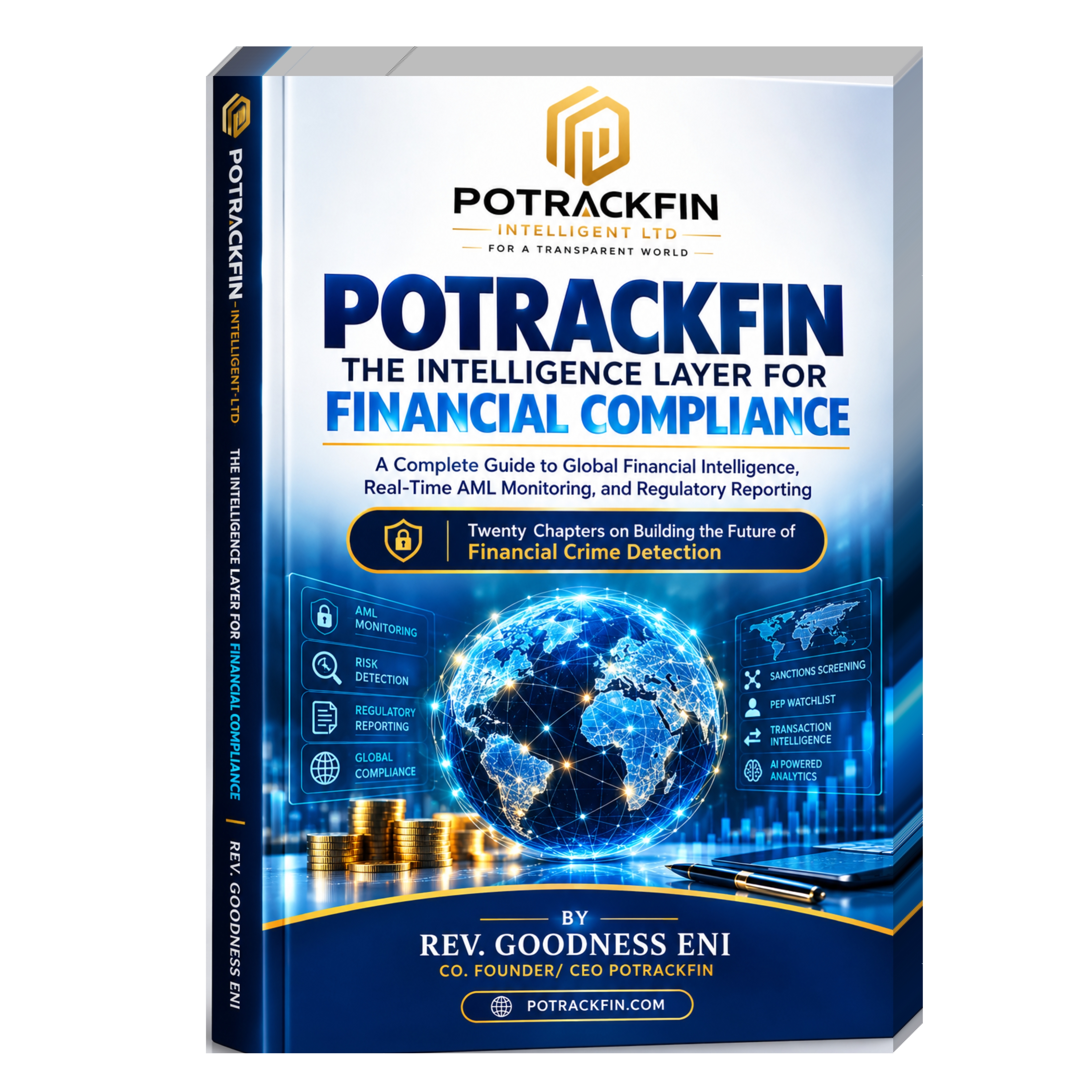
POTRACKFIN INTELLIGENT LTD
A Complete Guide to Global Financial Intelligence, Real-Time AML Monitoring, and Regulatory Reporting
About this Publication
CHAPTER 1
THE NEW AGE OF FINANCIAL CRIME
Financial crime no longer announces itself. It moves in fractions of a second, disguised as ordinary commerce, hidden inside the very rails that banks, fintechs, and payment networks use to serve legitimate customers every day. A wire that looks like a vendor payment. A card transaction that looks like a subscription renewal. A remittance that looks like a family sending money home. Behind a small percentage of these routine flows sits something else entirely: layered proceeds of crime, sanctioned counterparties, shell structures, and networks built specifically to defeat detection. The institutions tasked with catching this activity are working against an adversary that adapts faster than most compliance programs can update their rulebooks.
The numbers tell an uncomfortable story. Global regulators levied billions of dollars in anti-money-laundering fines in a single recent year, a figure that keeps climbing even as institutions spend more on compliance staff, software, and training than ever before. The paradox is not that organizations are careless. It is that the tools many of them still rely on were built for a slower, smaller, less interconnected financial system. Batch-processed reviews, static rule lists, and siloed case files cannot keep pace with a world of instant payments, cross-border fintech rails, and criminal networks that route funds through a dozen jurisdictions before a human analyst even opens a queue.
Consider the operational reality inside a typical compliance department. Analysts spend the majority of their week triaging alerts, the overwhelming majority of which turn out to be false positives — legitimate transactions incorrectly flagged because a rules engine matched a name, a country, or a transaction pattern too broadly. Industry surveys routinely put false-positive rates for legacy screening tools above eighty percent. Each of those alerts still requires a human to open it, review supporting documents, check watchlists, and document a decision. Multiply that by thousands of transactions a day, and the arithmetic of manual compliance stops working long before the criminal activity stops.
Meanwhile, the actual threats have grown more sophisticated. Structuring — breaking large transactions into smaller ones to stay under reporting thresholds — is now automated by the same actors it is meant to evade. Layering through cross-border corridors, exploitation of correlated but differently-spelled entity names, and rapid movement of funds through intermediary accounts before a suspicious activity report can even be drafted are no longer edge cases; they are standard tradecraft. Financial Intelligence Units around the world report that a significant share of confirmed suspicious activity is discovered only after legacy detection systems failed to flag it in real time, meaning the damage — reputational, regulatory, and financial — has often already been done by the time a human notices.
This is the environment into which Potrackfin was built: a global financial intelligence and AML compliance platform designed not to bolt another rules layer onto an already overloaded stack, but to rethink the entire pipeline — from the moment a transaction is initiated to the moment a regulator receives a report — as a single, real-time, intelligence-driven process. Rather than asking compliance teams to work harder inside broken workflows, the philosophy behind the platform is to make the workflow itself faster, more accurate, and more defensible under audit.
The chapters that follow examine that philosophy in detail: how Potrackfin ingests and screens transactions in real time, how it distinguishes genuine risk from noise, how it supports investigators with graph-based intelligence and automated narrative drafting, and how it is built to serve everyone from a five-person fintech startup to a national financial intelligence unit. But the starting point for all of it is this simple observation — financial crime has already moved into the digital, instantaneous, cross-border era. Compliance technology has to move there too, or the gap between the two will keep widening, one unfiled report and one unnoticed pattern at a time.
What makes this moment different from previous waves of regulatory technology is not just the sophistication of the threats, but the convergence of expectations. Regulators want faster reporting and better documentation. Executives want lower false-positive rates and lower headcount costs. Customers want onboarding that takes minutes, not days. Board members want assurance that a single missed red flag will not become a front-page enforcement action. No single legacy tool was ever designed to satisfy all four constituencies simultaneously — which is precisely the gap a modern financial intelligence platform is built to close.
Consider what this means for a mid-sized regional bank weighing whether to modernize its compliance stack. The calculus is rarely about a single dramatic failure; it is about the slow accumulation of risk that comes from running an analog process inside a digital financial system. Every quarter a legacy tool remains in place, the gap between the sophistication of the threats it faces and the sophistication of its detection logic widens a little further, and the eventual cost of closing that gap — in fines, remediation, and reputational repair — grows larger. Institutions that treat compliance modernization as a strategic priority rather than deferred maintenance tend to be the ones that avoid becoming the next enforcement headline, precisely because they closed the gap before it could be exploited at scale.
Authored by Pastor Goodness Eni, this publication is structured to guide readers step-by-step through foundational biblical truths, character formation, and victorious Christian living.
Key Spiritual Takeaways
- Unwavering commitment to sound biblical doctrine
- Practical habit applications for daily discipleship
- Authoritative prayer declarations for supernatural victory